
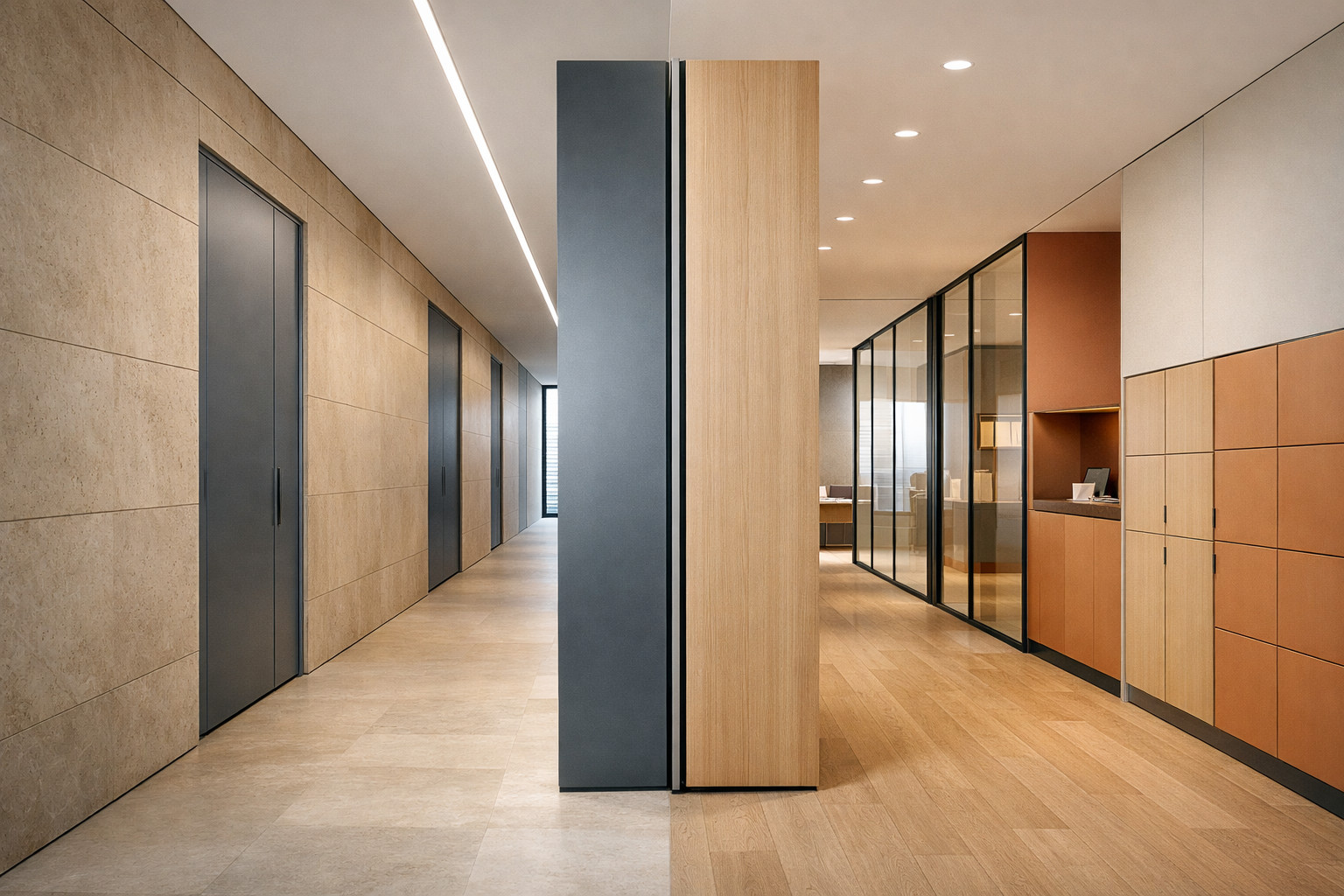
Milan’s office market no longer moves as a single block. Prime towers around Porta Nuova command rents approaching 800 euros per square metre a year, while a growing share of occupiers now ask for shorter, serviced commitments instead of ten-year leases. For developers and asset managers, this split changes what an office real estate marketing strategy has to do. A campaign built for a traditional, long-lease building rarely converts on a flexible floor, and the reverse is just as true. This article breaks down how the two models diverge in Milan, what that means for positioning, and how to build an office real estate marketing strategy that fits the asset in front of you.
What Is an Office Real Estate Marketing Strategy for Flexible vs Traditional Space?
An office real estate marketing strategy built for a traditional lease asset centers on long-term tenant relationships and credit-quality demand. Positioning speaks to headquarters-level decisions: location prestige, floor plate efficiency, certifications, and occupancy cost measured over a six to ten year horizon. A flexible asset competes on a different axis entirely: speed, service depth, and the adaptability of the format itself, from spec suites to fully managed offices with shared amenities. Its marketing strategy has to sell an experience and a lower-risk capital commitment, not just square metres. Treating both assets the same produces generic messaging that undersells whichever model the building actually represents. This is where local market intelligence becomes central to the work: identifying which occupier segments in a given Milan submarket are shifting toward flexible space, and which still commit to conventional multi-year leases.
Why Milan’s Office Market Is Splitting Between Flexible and Traditional Demand
The shift is measurable, not anecdotal. CBRE’s 2025 European Office Occupier Sentiment Survey found companies allocate roughly a fifth of their portfolios to flexible space on average, a share expected to climb further within two years as businesses build in agility against uncertain headcount planning. Investor behaviour confirms the trend: recent acquisitions of established flex operators by major landlords and investment groups signal growing institutional confidence in the model, and several large owners have launched their own proprietary serviced-office products rather than leaving the category to third parties. At the same time, traditional prime stock is not losing ground. Colliers reports Milan prime CBD rents reaching roughly 800 euros per square metre a year in the final quarter of 2025, with Milan accounting for close to forty percent of Italy’s total office investment volume in that period. Cushman & Wakefield describes the Milan and Rome markets in early 2026 as highly selective, with constrained supply concentrated in central, high-quality assets. Flexible and traditional office are not competing for the same tenant; they are absorbing different segments of the same demand curve.
How Tenant Sector Preferences Shape the Right Office Real Estate Marketing Strategy
JLL’s research on Italian office occupiers shows that technology, banking and finance, and professional services firms together account for more than sixty percent of Milan and Rome take-up, with legal and financial tenants concentrating in central business districts and professional services distributing more widely across the city. A marketing strategy for a flexible asset targeting technology tenants should lead with speed of onboarding and scalability. A strategy for a traditional building courting a banking headquarters should lead with prestige, stability, and location signaling instead. Building one narrative for both audiences dilutes the message that either group actually responds to.
How to Build an Office Real Estate Marketing Strategy for Either Model
The process starts with a submarket audit: current vacancy, rent trajectory, and the mix of flexible versus traditional supply already competing for the same tenants. From there, the office real estate marketing strategy needs a narrative calibrated to the asset, not a generic template borrowed from another project type. Channel selection follows the narrative: flexible product benefits from always-on digital demand generation and shorter sales cycles, while traditional leasing relies more heavily on broker relationships, direct outreach, and longer-form positioning content aimed at decision committees. Underneath both, a shared layer of CRM, geomapping, and performance tracking keeps the pipeline visible regardless of which model the asset follows. Stakeholder communication also differs: flexible assets answer mainly to occupiers and operators, while traditional and mixed-use projects often need parallel messaging for investors, tenants, and, in larger developments, municipal stakeholders.
Benefits, Risks, and Trade-offs of Flexible vs Traditional Positioning
Flexible positioning offers faster lease-up and strong appeal to occupiers facing workforce uncertainty driven by AI-related restructuring, but it carries revenue volatility and higher service-delivery cost that a marketing narrative cannot paper over. Traditional positioning offers rent stability, reflected in the 5.3 percent year-over-year prime rent growth CBRE recorded for Milan, but it typically means longer void periods and less appeal to smaller occupiers who now expect flexibility as standard. Neither model is inherently stronger; the right choice depends on the asset’s location, tenant pool, and the developer’s tolerance for either volatility or vacancy.
Alternatives: Hybrid Positioning for Mixed-Use or Repositioned Assets
A growing number of landlords are not choosing one model exclusively. CBRE notes that owners are embedding an element of flexible space within otherwise traditional assets, either through an in-house managed suite or a partnership with a third-party operator. For a repositioning or mixed-use project in Milan, this hybrid approach can widen the addressable tenant pool without requiring two entirely separate marketing strategies, provided the positioning narrative clearly signals which floors or wings serve which audience.
Conclusion
Flexible and traditional office assets in Milan answer to different tenants, different timelines, and different proof points. An office real estate marketing strategy only performs when it is built around which of these models the asset actually represents, supported by current local market data rather than assumptions carried over from a different project. Developers weighing a launch, repositioning, or stalled absorption should treat that choice as the starting point of the strategy, not an afterthought to it.
If you are deciding how to position an office asset in Milan, whether flexible, traditional, or a hybrid of both, SHARP can review your current approach against real submarket data and tenant demand. Request an assessment to get a clear, evidence-based view of where your positioning stands and what an office real estate marketing strategy tailored to your asset should prioritize next.